By the Application Engineering Team at ProTech Transfer Co., Ltd.
Most jewelry workshops are built around Gold and Silver. The Casting machines, the habits, the intuition, all of it is tuned to precious metals that flow freely and forgive small mistakes. Then a client asks for stainless steel and suddenly the rules change completely.
Stainless steel investment casting is one of the fastest-growing areas in the jewelry industry. Watches, clasps, rings, pendants, surgical-grade jewelry and high-wear fashion pieces are driving demand. But many workshops that try to make the jump end up with the same frustrating results: rough surfaces, incomplete fills and high reject rates. The good news is that these problems are not bad luck. They are predictable and they are fixable.
The Metal Is Not the Problem. The Process Is.
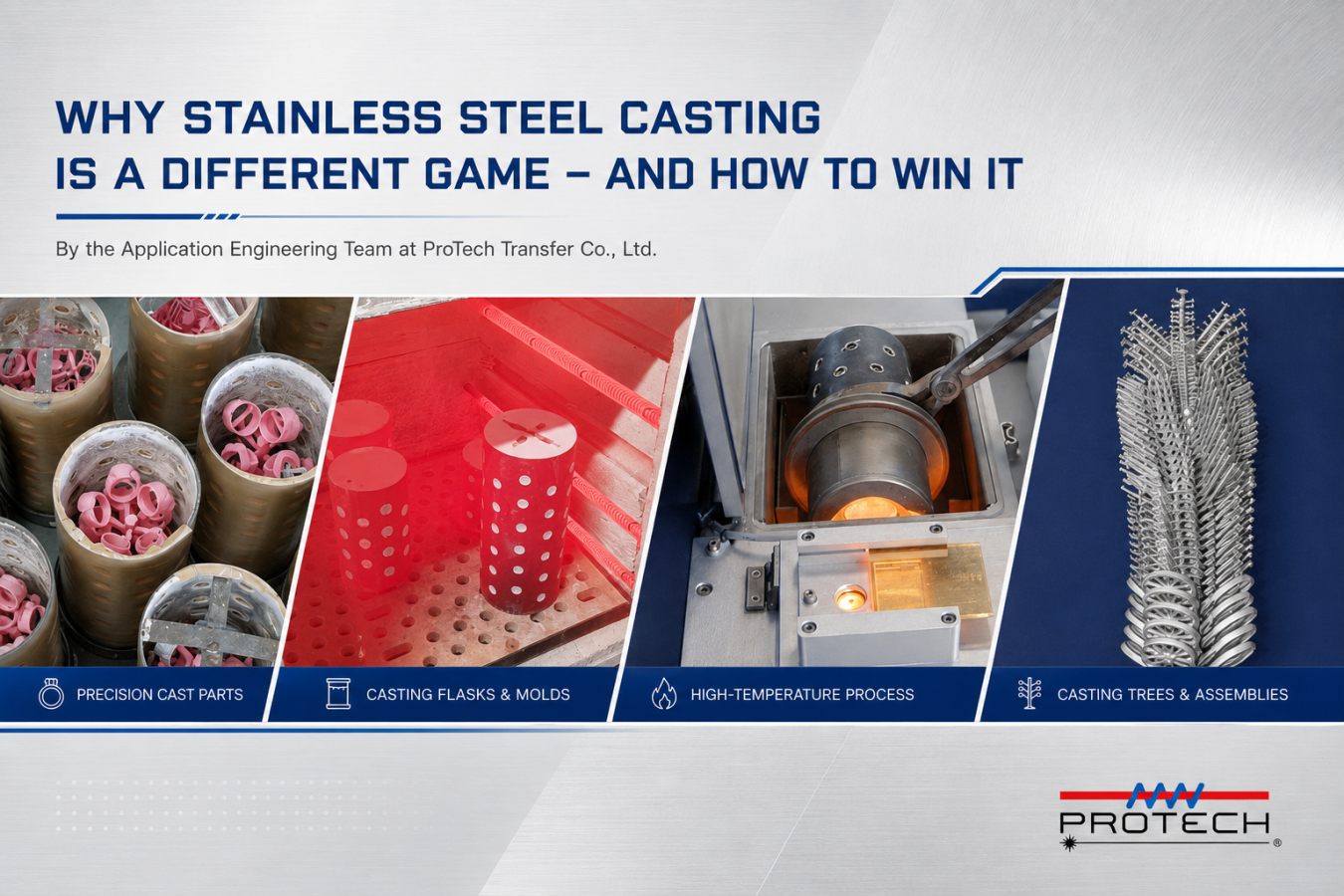
Gold melts at around 1,064°C and flows easily into a mold, while stainless steel casting requires temperatures near 1,500°C and exhibits very different metal flow behavior, moving more like a viscous fluid. This fundamental difference impacts the entire casting process, starting with a critical but often underestimated factor: wax tree design.
A sprue design and feeder system that performs well for gold and silver will fail in stainless steel casting. The metal is heavier, flows slower and solidifies faster in narrow channels. To ensure proper mold filling, sprues must be significantly larger — typically 1.2 to 1.5 times the thickness of the thickest section. Undersized sprues lead to premature solidification and incomplete casting defects, which cannot be corrected by adjusting temperature control alone.
Similarly, properly sized feeders are essential. As stainless steel undergoes approximately 4% solidification shrinkage, insufficient feeders result in internal porosity in casting, often undetectable until finishing — at which point the piece becomes scrap. Optimized feeder placement ensures continuous metal supply, improving casting quality and reducing reject rates.
Investment Selection: The Step Most Workshops Get Wrong
If your workshop currently uses gypsum-bonded investment, the standard plaster for gold and silver, you cannot use it for stainless.
Gypsum breaks down between 700–800°C, releasing sulphur gases directly into your mold. Those gases dissolve into the molten stainless steel and appear as gas porosity, small bubbles trapped inside the casting that weaken the piece and ruin the surface. The correct choice is phosphate-bonded investment. It remains stable well above 1,000°C, expands predictably so the mold does not crack and allows gases to escape rather than trap. Switching investment material alone eliminates one of the most common casting defects workshops experience when moving to stainless.
Temperature Control: Narrow Windows, Big Consequences
Stainless steel has a very specific pouring window: between 1,500°C and 1,550°C. Below that, the metal begins to freeze before it fills the mold, this is called a misrun and it means an incomplete casting. Above that range, surface quality degrades rapidly.
Your flask also needs to be at the right temperature when you pour — typically 850–950°C depending on section thickness. A mold that has cooled too much will cause the metal to freeze in the channels before reaching thin sections. This is one of the leading causes of incomplete mold filling in jewelry casting and it is almost always a temperature management issue rather than a machine issue.
Pouring Method Matters More Than You Think
Modern casting machines designed for difficult alloys like stainless, platinum or palladium, use a tilting pour system rather than a traditional bottom-drain crucible. When the crucible tilts, the metal is transferred horizontally rather than dropped from above. This smooth, wave-like motion keeps impurities at the surface rather than folding them into the casting and combined with vacuum-assisted filling, it pushes metal into fine details that low-fluidity alloys would otherwise leave unfilled.
The result is a dramatic reduction in casting rejects (reduce casting reject), cost reduction in casting and a surface finish consistent enough to go directly to polishing without remedial work.
The Takeaway
Stainless steel casting rewards process discipline and process optimization. By upsizing your sprue design and feeder system beyond what gold and silver require, switching to phosphate-bonded investment and maintaining precise temperature control, your casting defects and reject rate will decrease significantly.
The learning curve is real, but with a clear understanding of metal flow behavior, solidification shrinkage and the root causes of porosity in casting, improvement comes quickly.
For workshops aiming to expand into stainless steel casting, platinum casting or other high-temperature alloy casting, ProTech Transfer Co., Ltd. provides technical consultation and industrial casting solutions in Thailand. www.protech-transfer.comThe Takeaway
Add a Comment